
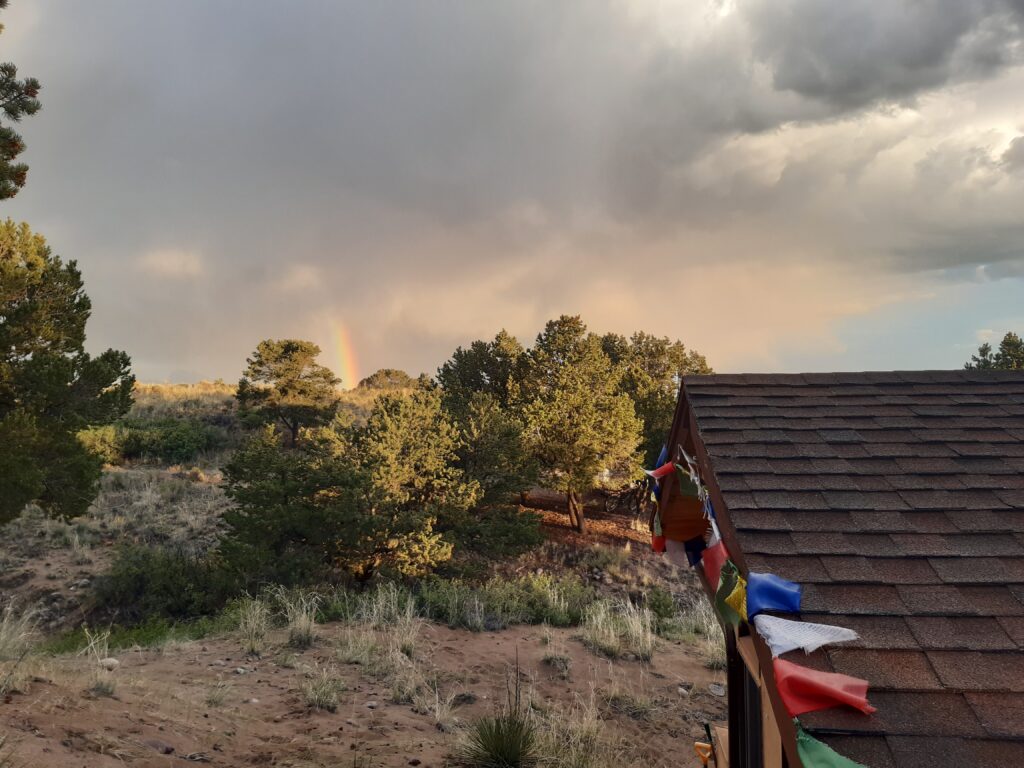
An anonymous retreatant at the CCR North America reflects on why retreat matters—not only to their own well-being, but also for the flourishing of the whole world.
—Jamgon Kongtrul Rinpoche
As one of my Dharma teachers once said, a long-term retreat is not an event—it’s a way of life. Somewhat surprisingly to myself, I’ve recently ventured into my second year of retreat here at Miyo Samten Ling. While reflecting on one’s achievements at what we perceive as calendar milestones might not be the best idea, I found it meaningful to share some of my thoughts and experiences when I was invited to do so.
Specifically, I’ll touch on topics such as the rationale and motivation for long-term retreat, dealing with upheavals and distractions, balancing effort and relaxation (both in formal practice and off the cushion), estimating progress, and living in a contemplative community. Hopefully, this will be of benefit to those considering engaging in such a retreat in the future, or to those who are simply curious about what we’re doing—or, rather, not doing—here.
There are plenty of reasons why someone might want to go into retreat: longing for peace of mind, frustration with or inability to cope with life’s circumstances, the intention to become a “better version” of oneself or a spiritual teacher, and even the desire to impress or please one’s own teacher(s). However, not all of these motivations are sustainable in the long term. One has to become completely disillusioned with worldly matters in order to devote oneself single-pointedly to Dharma practice. The four revolutions in outlook are specifically designed to reorient us toward Dharma, but one needs to relate them to one’s own life experience; otherwise, they will remain at the level of mere affirmations.
I’d dare say that authentic practice in retreat—and Dharma practice in general—has little to do with reaching a more comfortable state of mind or becoming a happier person, although these can arise as byproducts of practice. Dharma practice is, first and foremost, concerned with fathoming the true nature of reality and then manifesting it through one’s being in the world. I like how Dzongsar Khyentse Rinpoche put it: “The bodhisattva vow is the vow to understand the Truth, and then help others to understand the Truth.”
In this respect, long-term retreat is a rare and precious opportunity to prepare one’s mind for such inquiry by means of śamatha, and then engaging in it by means of vipaśyanā, which, when united, lead to genuine inner transformation. Such deep work is only possible in seclusion, where there are minimal distractions and a unique chance to encounter your demons face to face, without covering them up with work, relationships, entertainment, or various addictions. Over time, you begin to see your coping mechanisms more vividly; you start to realize how deeply confused we are as sentient beings—and that the only path to healing lies in fully understanding and transcending one’s delusion.
That said, it’s certainly not the case that one cannot be of benefit to others without first spending a few years in retreat. As Lama Alan pointed out in a recent Wisdom Dharma Chat, “You don’t need śamatha to help other people—you can help them in myriad ways, including teaching basic meditation, yoga, bodhicitta, and so forth. Sometimes your companionship is what people need more than anything else.”
Ideally, one has already developed authentic motivation, renunciation, self-confidence, and all other inner prerequisites before entering long-term retreat. In reality, however, that’s not always the case—at least, I wasn’t so well prepared and didn’t know whether I’d last more than a few months. The good news, though, is that we can continue cultivating these qualities while in retreat. Eventually, if we are persistent enough, Dharma practice will scrape away our superficial preconceptions about what we truly want and how that can be actualized.
As many of you probably know, intense meditation practice can often catalyze various meditative experiences or upheavals, known in Tibetan as nyam. In fact, as Dr. Eva Natanya stated in her Wisdom Dharma Chat talk, “In retreat, you come to face your personal samsara . . . So we need the courage to persevere through the many layers of ourselves.” Upheavals differ from person to person and can manifest as physical or psychological conditions, or as external events—both pleasant and unpleasant. One thing is certain: you’re going to learn a lot about your own psyche, including the contents of your unconscious mind.
I’ve found that taking the stance of an explorer-observer helps me gain a bit of distance from the mind’s contents and avoid being completely swept up in them. Although at some point we need to lose interest in whatever arises and simply notice it, in my experience this often only becomes possible once I’ve understood what it is that repetitive nyam are trying to “tell” me. In this regard, especially if a specific upheaval or pattern persists over a long period, a psychological consultation might be helpful as a complementary way to figure it out.
Another powerful technique is to apply vipaśyanā by asking oneself, “Who is experiencing this now?”—a question that naturally leads to disentanglement. In his recent Dharma talk available in our Seeds of Wisdom library, Doug Veenhof describes this method, along with other ways in which we can use vipaśyanā to support our śamatha practice.
For beginners like myself, rumination is probably one of the main challenges, apart from upheavals. The egoic mind is remarkably ingenious and cunning—it’s like a YouTube algorithm that knows exactly what to show you to grab your attention. You have to stay constantly vigilant, as it always finds new ways to seduce you into rumination and thus sabotage your practice. But watching the mind’s tricks can be even fascinating at times.
My favorite meditation instruction is extremely simple yet profound: “No distraction, no grasping,” by Lerab Lingpa. Awareness can be as vast as space, and yet grasping arises and collapses it down to the size of a single thought or sensation. In fact, only through intensive practice have I begun to notice how contracted my mind is most of the time. But by simply noticing this again and again, the claws of grasping gradually loosen and give way to spaciousness.
Although awareness itself is effortless, it takes a certain effort to overcome our habitual propensities for mind-wandering and dullness. As Lama Alan remarked in one of his teachings, “You’re not tired of awareness, you’re tired of practicing poorly.” To practice efficiently, one needs to find a very subtle, dynamic balance between effort and relaxation. For me, this hasn’t been easy; sometimes I still veer toward one extreme or the other and end up either exhausted or overindulging in distractions.
The simple technique of first arousing awareness and then releasing it is generally meant to address this problem within a meditation session. It can also be helpful on a larger scale. Once, I experienced a major burnout by exerting myself too much for nearly a month, and it took me weeks to recover from the resistance to practice that followed. I think it is very important to be realistic about how many hours of formal practice one can afford at the moment and not push too hard. Being kind to oneself is crucial, but in my case, it is also important to watch out before this kindness mutates into self-indulgence.
Regarding striking this delicate balance, I resonate deeply with what Dr. Eva Natanya writes in her extremely helpful overview of the CCR’s first five years: “The most important first step is to find contentment with being in retreat—being alone with one’s mind and body, free of major hedonic stimuli, without needing to rely upon conversation or social engagement to stay inspired.”
Of course, subjectively, there can be “good” and “bad” days, but when one finds this general contentment in simply being here and now and practicing Dharma, these fluctuations no longer matter. Continuous practice gradually loosens the grip of attachment to external stimulation, so there is no need to impose radical austerities artificially, although some restrictions on Internet use or socializing can certainly be helpful!
Despite having heard many times that a Dharma practitioner must go beyond all hopes and fears, I’ve found that it’s easier said than done. Each small “milestone” in retreat—three months, half a year, a year—would bring up doubts and a sense of unease about whether I’m progressing enough. Lama Alan compared this tendency to planting tree saplings and then trying to pull them upward so they grow faster, which, of course, is absurd.
It seems that the expectation of rapid progress is what hinders it the most. And, in fact, any expectations at all. The main and only task is simply to return to the practice again and again, without unnecessary commentary or self-reproach. And then one day you notice that something has shifted, something has changed, something has fallen away, something new has appeared.
I think it’s important to cultivate trust in the natural unfolding of things, since the desire to control and the longing for achievements come from our egoic mind, which is, in a way, a product of dualistic grasping. But the desire for quick results—especially at the beginning—is very typical of modern people who have only just pulled themselves out of an endless race for “successful success” and are trying to recover, or rather, return to their true selves. And this process, in most cases, is gradual.
Before I arrived at our hermitage, I somewhat underestimated the importance of practicing in a community of like-minded people, since I had never had such an experience before. But now I realize that if it weren’t for the kindness and generous support of my teachers and Dharma siblings, I wouldn’t have lasted long in retreat.
Even though most of the time we spend in our isolated cabins on our own, there is a sense of fellowship that sustains us in our individual quests. Occasional interactions can take the form of silent salutations, exchange of written notes or emails, sharing food, or a meaningful conversation once in a while. Besides, there are regular monthly gatherings in our Chapel for teachings and communal practice, which also greatly support our retreat.
I would like to express my deep gratitude and admiration to all my fellow retreatants who were or are currently practicing at MSL or elsewhere; to our incomparable caretakers, thanks to whom all problems are quickly solved and groceries arrive on time; to our wonderful administration for running the hermitage and helping with paperwork; to all the generous supporters donating to the CCR’s Retreatant Support Fund, which allows some of us to continue our retreats; to our Research and Education Director for her extraordinary warmth and support; to all the volunteers who help with multiple tasks; and to the CCR’s benefactors and friends, without whom all this would not be possible. First and foremost, I am forever grateful to Lama Alan and my other Dharma teachers, who with great patience and compassion guide sentient beings toward awakening.
Sarva Mangalam!