
Fathom the Mind Podcast
On Fathom the Mind, we explore what cutting-edge science and rigorous contemplative practice can tell us about the nature of consciousness.
In this exploration, we hope to empower our listeners to live lives of both intellectual integrity and contemplative depth.
Why this podcast?
Why now?
On Fathom the Mind, we interview experts in the fields of both modern science and contemplative practice in order to explore the nature of consciousness.
Interweaving expert knowledge and the personal experiences of guests, we facilitate well-rounded conversations about the nature of consciousness, all while upholding the rigor that true scientific inquiry demands. Through this exploration, we hope to demystify and advance the conversation around consciousness in the modern world. Every so often, we’ll also discuss mind-training tools that not only support our ability to think clearly and scientifically, but also help us cultivate a deep sense of well-being.In so doing, we hope to empower our listeners to live lives of both intellectual integrity and contemplative depth.
Our latest episode
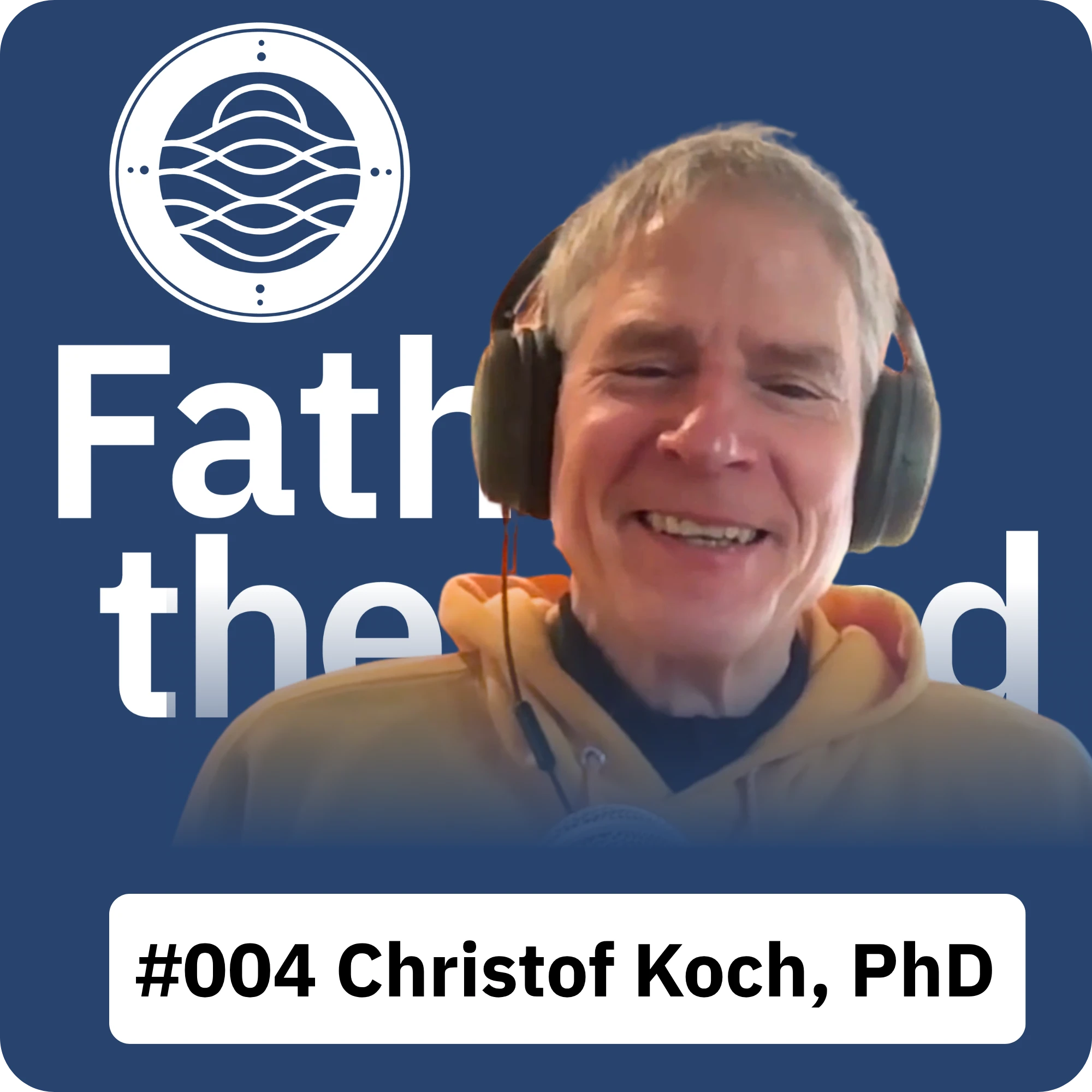
Our guest on this episode is Christof Koch, PhD. A physicist and neurobiologist, Christof was a professor of biology and engineering for more than 25 years at Caltech. In 2011, he became the Chief Scientist at the Allen Institute for Brain Science in Seattle and in 2015, he became its president. He remains at the Allen Institute, now as a Meritorious Investigator, and is currently the Chief Scientist of the Tiny Blue Dot Foundation in Santa Monica, where he seeks to understand consciousness, its place in nature, and how this knowledge can benefit all of humanity.
We are glad to share this energetic conversation between Nick and Christof with you today. As you’ll hear, they discuss a wide range of topics—including quantum computing, the neural correlates of consciousness, how mystical experiences come about, and even Christof’s own experience with psychedelics. They also discuss Christof’s qualms with the worldview known as physicalism—sometimes called scientific materialism.
Physicalism is still the dominant worldview in academia today, but its limitations are becoming more evident, as Christof and Nick discuss at length in this episode. After decades in neuroscience, Christof finds some of the metaphysical claims of physicalism to be naive. This framework has given us extraordinary explanatory and technological power over the material world, but it’s also left us with a striking lack of consensus about the nature of consciousness. We at the CCR hope that conversations like this one encourage people to consider what might become possible if we carefully relax some of the methodological constraints that have been motivated by the physicalist picture of reality.
We hope you’ll stick around until the end of this episode, where Christof discusses his plans upcoming plans for a dark retreat: a kind of meditation retreat performed in complete darkness, which Nick also happens to have done himself. We hope you enjoy and benefit from this conversation.
Episode archive:
Find all of our episodes below. More episodes will be added soon.
Physicalism is still the dominant worldview in academia today, but its limitations are becoming more evident, as Christof and Nick discuss at length in this episode. After decades in neuroscience, Christof finds some of the metaphysical claims of physicalism to be naive. This framework has given us extraordinary explanatory and technological power over the material world, but it’s also left us with a striking lack of consensus about the nature of consciousness.
In their dialogue, Jetsunma and Dr. Eva Natanya cover a wide range of topics—including Buddhist monasticism, psychological upheavals in retreat, mind-training in daily life, and the roles of neuroscience and contemplative practice in studying the nature of consciousness. Across all these topics, one can trace a common thread: that true mental balance is accessible to all of us, so long as we can commit to training our minds in whatever circumstances we find ourselves.
Prof. Michel Bitbol’s career spans the fields of medical science, quantum physics, and philosophy of mind. But along the way, there was one basic question that became harder and harder to ignore: What role does consciousness play in scientific research?
At the heart of many contemplative traditions, astrophysicist Piet Hut recognized echoes of the scientific method: the process of formulating hypotheses and testing them with replicable experiments.