
How it works: the hermitage environment and retreatant support for long-term retreat
Today, we’d like to share more about the logistical aspects of retreat at the CCR: our hermitage grounds and accommodations, application process, and our mechanisms for providing financial support for retreatants.
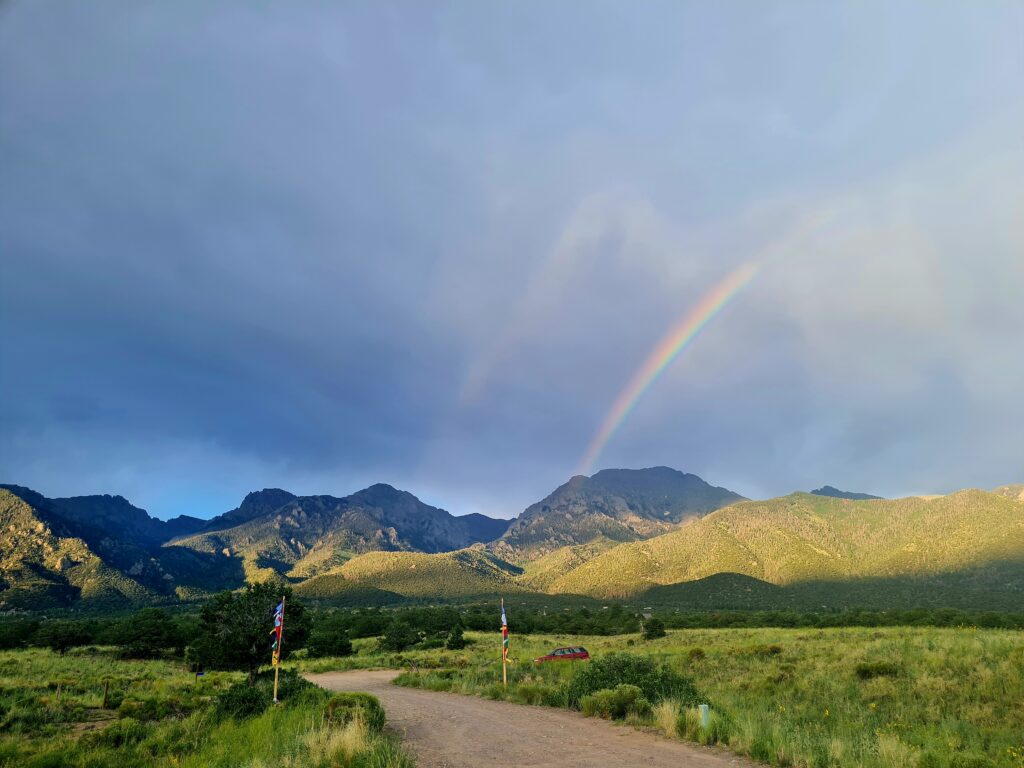
Miyo Samten Ling (MSL) is a sprawling complex of buildings on 110 acres of land, in a transitional zone between brushland and juniper/piñon forest on gently rolling hills next to the expansive Baca Wildlife Preserve in southern Colorado. Our fourteen actively occupied retreat cabins are located in carefully spaced arrangements in multiple areas of this land. Retreat cabins are nestled among small hills such that they are not visible to each other, but are within easy walking distance. This affords a balance of isolation and proximity—retreatants are palpably both in solitude and among spiritual community.
The retreat center complex includes:
The standard retreat dwellings are sustainably built frames with stucco exterior, and include a bedroom, kitchen area, study/practice area, and bathroom. In the winter, they are heated by both small woodstoves and the remarkably powerful passive solar influence of the desert sun at high altitude. Retreatants settle into these dwellings for weeks, months, or years, depending on their experience and intentions as carefully decided in collaboration with their spiritual teachers and guides.
Practitioners who are interested in long-term retreat at Miyo Samten Ling begin by completing a detailed application, viewable here. This application asks prospective retreatants to reflect deeply on their current meditation practice, their history of study and practice, and their retreat intentions; to share about their meditation teachers; and to include important practical details about their overall mental and physical preparedness to live in solitude in a remote environment. If an applicant is considered to be a promising candidate for retreat, and if cabin openings are anticipated within the applicant’s requested timeframe to begin retreat, an interview process commences. A prospective retreatant will usually have an interview via video call with one of our resident teachers, and sometimes another interview with a CCR staff member, which allows time for extensive conversations to help us understand a practitioner’s contemplative journey, readiness, intentions, concerns, questions, and beyond. We also request reference letters from others familiar with the applicant’s spiritual history.
Entering into extended retreat is a decision that must be made and prepared for very carefully, and over the years since our founding, we have learned much about how to best understand whether a person has the contemplative background, mental and social stability, logistical preparedness, life experience, and physical health to be equipped for extended full-time practice at MSL. Applicants are accepted from a variety of backgrounds: CCR retreatants reflect a wide range of ages, educational and professional backgrounds, geographic and ethnic heritages, and spiritual lineages.
The waiting list for retreat at the CCR is managed dynamically: some prospective retreatants are planning years in advance for open-ended retreat as they navigate necessary practical decisions and preparations to move to the CCR long-term, while others are ready to come for 2- to 3-month retreats at shorter notice. Still others have completed and continue to return for repeated retreats of 6 months or more, creating an arc of deepening retreat practice over the course of years. These cadences, together with immediate preparation for retreat through sustained practice while still at home, are designed on a case-by-case basis in close collaboration with CCR resident teachers and in accordance with the fluctuations in cabin space available at MSL.
As described above, the CCR’s first priority is to identify retreatants who are qualified for long-term retreat and who have a heartfelt, deeply rooted aspiration to enter into retreat at MSL. Then, it is our priority to make it possible for them to do so, whether for months or years. Our Retreatant Support Fund is one way we do this.
If retreatants are financially able to donate to the CCR in support of their retreat, the suggested monthly charitable contribution range is currently $900–1200. These contributions enter a general fund that helps cover a proportion of the operational expenses incurred by the CCR in managing the needs of the hermitage; the rest of our operational expenses are covered by donations from our generous individual and institutional supporters. As a nonprofit, the CCR seeks adequate funding for the retreat program: to ensure that the retreat environment is safe and comfortable, that retreatants’ needs are met, and that the necessary outer conditions for dedicated practice are maintained. Retreat stewards shop for and deliver groceries to boxes outside retreatants’ cabins on a weekly basis, enabling retreatants to continue in the flow of retreat without ever leaving the hermitage property to purchase food and supplies.
Hermitage-related costs include:
The CCR’s Retreatant Support Fund was created to make retreat possible for people of varied financial means, understanding that while a prospective retreatant may be qualified for long-term retreat, that individual may not have the financial capacity to offer the suggested monthly donation in support of retreat.
In these cases, they offer what they reasonably and responsibly can in charitable support of the retreat program, and the CCR contributes the remainder of funding in support of their retreat. To date, the CCR has provided over $160,000 of retreat funding for current and former retreatants, in reliance upon the Retreatant Support Fund. We are so grateful to our donors for making this rare opportunity for financially supported retreat possible, since it is very difficult to find such circumstances, especially outside of Asia.
When retreatants arrive for retreat, they are given a “bimonthly reporting date” on which to submit a detailed written report to the spiritual director, Dr. B. Alan Wallace, responding to eight specific questions about the quality and continuity of retreat practice, experiences and challenges, and about how they are maintaining physical, mental, and spiritual balance from day to day, week to week. Dr. Wallace usually responds within a day, offering practice suggestions, encouragement, and sometimes directing practitioners to specific passages in books or to a particular recorded teaching in order to help clarify their understanding of a particular element of practice.
Retreatants are invited to reach out to the spiritual director or one of the resident teachers at any time when a specific question or difficulty arises in practice, and when written correspondence is not the right medium with which to address an issue, retreatants meet individually with one of the resident spiritual guides at the hermitage. Guidance is highly personalized to the specific needs of individual retreatants during different periods in their retreats and spiritual growth. At times more one-on-one conversation is appropriate as a form of spiritual guidance and at other times more thoroughly sustained silence is the pathway for deepest maturation.
Our three resident instructors take turns in offering regular teachings to the hermitage and to our wider community online at monthly gatherings. Teachings and guidance are always free of charge, and our three resident spiritual guides do not receive salaries at the CCR. Several licensed psychologists are available for pro bono clinical counseling at any time if the need should arise for an individual retreatant.
We’ll share more on the topic of retreat guidance soon, including how we have evolved in our approach to leading retreatants into more and more continuous meditation practice in a sustainable way.
If you are interested in a retreat at MSL, you can explore the retreat page here, or reach out to us with questions at info@centerforcontemplativeresearch.org.