
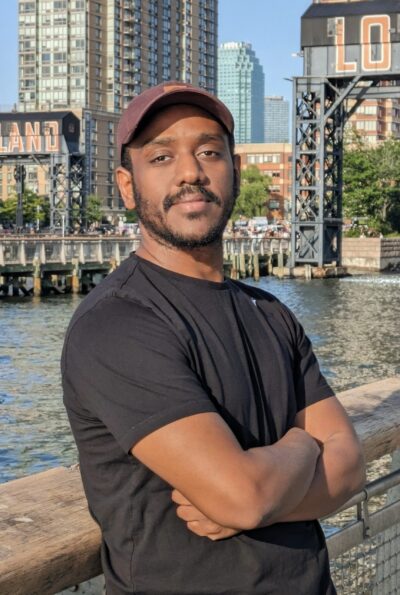
In attempting to discover the best way to serve others through a career in science and medicine, Tesfa Demeke finds that “changing systems and structures is not enough to build a more humane society so long as we ignore the inner worlds that motivate us."
For much of my professional life, I thought I was trying to understand and help other people using the tools of science and medicine. Beneath that effort, however, was a subconscious journey toward understanding myself.
I was raised in Ethiopia between two different accounts of human suffering and flourishing. My father had come of age amid the upheavals of the 1960s, witnessing countless communist revolutions and the struggle for independence across the African continent. Determined to teach me about civil strife in his world, he made sure I understood the allure of authoritarian leaders, the roots of inhumanity, and how education can be a catalyst for justice. My mother gave me a different, less secular inheritance. Deeply religious and formed by the ancient traditions of the Ethiopian Orthodox Church, she asked something more intimate of me. She wanted me to embody the cardinal virtues and develop character more than anything else.
I spent a while trying to reconcile these two seemingly different obligations, one directing me toward the forces that govern collective life and the other toward the cultivation of the mind and a relationship with God. Eventually, I came to see they were two sides of the same coin because both are attempting to answer the same enduring question of how and why humans are capable of both suffering and flourishing, exuding light and darkness. These influences compelled me to examine society without losing sight of the individual, because I believed insight into collective life begins with an understanding of human consciousness.
I studied neuroscience and psychology in college in pursuit of answers to these questions. In graduate school, I turned toward philosophy and health policy because I imagined a medical career where I could heal individual minds while keeping the broader social forces of human suffering in view. Groups are made up of individuals, after all. Yet, my movement toward a medical career was faster than my understanding of what medicine could and could not do. I assumed the tools of science and clinical care would give me an unusually direct way to impact as many lives as possible. But thousands of hours in hospitals working in clinical research and care delivery gradually complicated that faith. I began to see structural limits in medicine and how often psychological suffering was poorly understood or left outside the boundaries of care, if properly recognized at all. The distance between medicine’s scientific sophistication and its understanding of mental suffering became too large to ignore. The scientism I had absorbed in academia did not survive prolonged contact with the healthcare system.
Then COVID arrived and gave me an unwelcome experiment in introspection. The external world became quiet, isolation set in, and the structures that had kept me moving suddenly fell away. Although I had lived in the United States for almost a decade by then, I felt new and foreign to the community around me. More unsettlingly, I looked inward and felt like a foreigner in my own mind. The loss of a close family member further complicated the situation and introduced me to a level of grief I had never experienced before, on top of a personal health crisis that made me contemplate my own mortality for the first time. Then came heartbreak. A relationship I had imagined would become a life together ended and I found myself in a depth of despair for which productivity offered very little help. I had spent years studying human suffering, but I had not learned how to suffer well myself. This was the beginning of what I now call my spiritual homelessness.
Suffering is already written into the equation of life. The question is how you solve for it. I understood this intellectually, but my first instinct was to drown my suffering through familiar ways of engaging with the collective. Meditation practices I encountered during the pandemic gave me some distance from my thoughts, but I was still tempted to turn that distance into productivity. There was always something to fix around me. There was scientism in medicine, social injustice throughout the world, and countless health problems affecting millions of people. Each seemed to demand attention and offered a respectable promise of escape. One can spend an astonishing amount of time trying to fix the world in order to avoid confronting oneself.
It was shortly after this period of crisis that a sequence of synchronicities brought Dr. Eva Natanya into my life, and with her the contemplative life entered my horizon. As a scholar of comparative religion and an extraordinarily generous teacher, Dr. Natanya gave me language for a possibility I had sensed but could not articulate: my Christian background did not have to place me in opposition to the contemplative traditions of the world. Our conversations allowed me to explore Christian contemplative traditions such as the Carmelites of the Catholic tradition alongside Buddhism, Taoism, and Sufism. These traditions had developed in different historical settings, yet were asking remarkably similar questions about the nature of the mind. I began to recognize that contemplative traditions across cultures had preserved forms of inquiry into the human condition that modern intellectual life has abandoned in favor of physicalism and positivism. My interaction with Dr. Natanya returned me to questions I had encountered before, such as what it means to live well and what it means to resist suffering, while opening doors to harder ones, such as what freedom may become possible for human beings when we pursue truth instead of specific mental states. The writings of St. John of the Cross and his idea of the dark night of the soul, for instance, began to speak differently to me when I confronted them alongside the Dzogchen tradition in Buddhism. I realized that the spirituality I sought did not require a new belief system. Rather, it required something more demanding: the cultivation of a contemplative life.
Dr. Natanya also changed the place of ethics in my understanding of human flourishing in a way that allowed my parents’ language of virtue and responsibility to converge. I had confronted questions of virtue in Western philosophy through thinkers such as G. E. M. Anscombe, Simone Weil, and Plato, but only now was I seriously asking what ethical framework was required to give substance to my ambition of easing mental suffering in others. Through her encouragement, I was exposed to retreats taught by Dr. Alan Wallace, which introduced me to Tibetan Buddhist contemplative practices and gave me the ability to drink straight from the firehose of Dharma. Through the retreats, I learned life-changing skills for observing the mind directly rather than just theorizing about it. I also encountered a richer account of happiness in the idea of eudaimonic flourishing—what Dr. Wallace calls genuine happiness. His focus on the looming metacrisis helped me place my own experience within a larger historical frame and gave me a way to understand why this moment feels different from other tumultuous times in the past, such as the one experienced by my parents. Our modern world combines incredible potential for prosperity and human flourishing with an equally incredible risk due to the fact that those in the driver’s seats remain driven by the fears, attachments, and unrecognized motives of the mind. Therefore, I saw clearly that changing systems and structures is not enough to build a more humane society so long as we ignore the inner worlds that motivate us. Dr. Wallace’s wisdom also clarified my frustration with medicine and why despite its remarkable scientific precision, the field often fails to comprehend suffering that cannot be labeled as disease.
I am currently in a period of long-term contemplative practice and service at Miyo Samtem Ling hermitage in Crestone, and am slowly learning what it means to tame the mind and understand its true nature. I am grateful for the unlikely sequence of synchronicities that brought me here. What comes afterward will be another question. But I know that I want to carry forward greater spiritual depth for myself, greater dignity for the patients I want to help, and a robust ethical framework for the work of healing minds. My spiritual path has therefore become neither an escape from the world nor an alternative to action.