
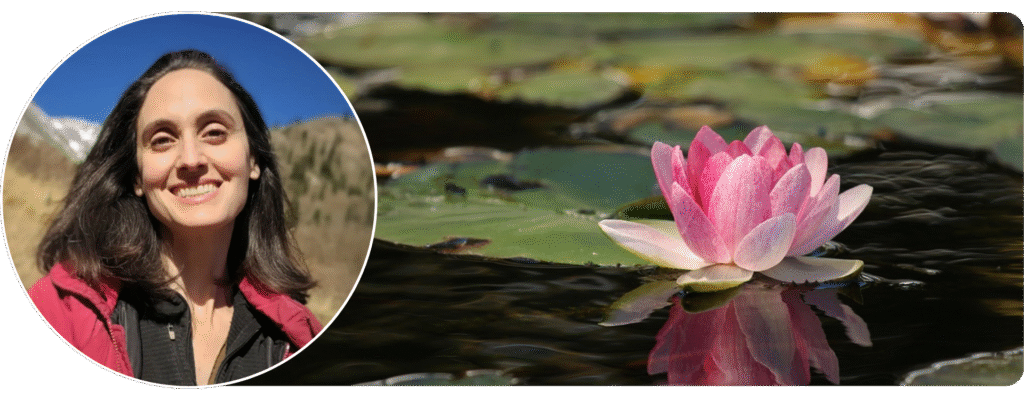
Sitatara—former caretaker and now a long-term retreatant at the CCR North America—reflects on the unexpected transformation she has experienced so far as a full-time contemplative.
I was tired of being stuck in survival mode—coping, moping, chaotic, neurotic, grasping for ground. After a childhood and young adulthood marked by abuse, followed by a lifetime of complex trauma—including every topsy-turvy way to cope with that trauma—I’d had enough. I couldn’t keep living on that helter-skelter, existential autopilot. I needed to be careful though that retreat wasn’t an excuse to run away from everything I no longer wanted to face. It’s true that sometimes, even here, it’s easy for the mind to slip back into old patterns of escape. Alas, such are the ways of facing one’s own personal samsara while dredging the ooey-gooey, sticky, stinky depths of the psyche—for it’s hard not to rely on one’s habitual ways of coping when squarely confronting all of the things one tucked and shoved neatly and deeply away in order to make it through each day. My habit has been to run away, both physically and figuratively. I’d become adept at not only traveling long distances with my body, but also with my mind. So, what happens when the running away that shadowed me as an endurance adventurer and a full-fledged trauma escapee screeches to a halt—and I stop, breathe, and embark upon an open-ended, solitary meditation retreat? An emerging from the mud, at last.
Upon stepping into my current open-ended retreat, I drew upon many of my survival strategies. My traumatized body and mind were convinced that something awful was about to happen as the familiar intensity of everyday life was replaced with a calm, quiet spaciousness… I had done several one-month retreats in preparation for long-term retreat, but I still found myself somewhat flailing about as I was diving into the mysterious depths of samsara’s ocean. Although this descent is ultimately a solitary pursuit, fortunately none of us have to navigate those depths completely alone nor without proper “equipment”: We have the deep-dive gear of these authentic practices and our “dive guides”—Lama Alan, Yangchen (Eva Natanya), our lineage teachers, and the awakened ones—as well as the support of the wonderful staff, volunteers, and CCR community around the world!
With that support in place, I could now meet what awaited beneath the surface—the grit and grime of my mind, laid bare in the stillness of retreat. But that’s not to say it all evokes reactions akin to Edvard Munch’s “The Scream” painting. That is, I also wouldn’t be discovering a wellspring that I’d only ever tasted drops of prior to retreat. The practices we’re given truly work to strip away all of the filth and fluff that keep us stuck on a perpetual hamster wheel of suffering and sorrow. Sometimes the stripping process can be painful and contracting; other times it can feel like a big release and a deep sigh… I’ve learned the hard way—that is, through a stubborn, habitual holding on—that it all goes much smoother the deeper one can relax. Even the little lessons about how best to support oneself, mentally and physically, in order to cultivate greater ease, can be taken into everyday life. Relaxing has become one of my sharpest, squishiest, softest, most supportive tools. With that foundation, the deeper work can then unfold in a gentle, manageable way.
Upfront, for me, the opportunity for retreat has been one to heal not only complex trauma, but also the deeper, more systemic trauma arising from a mind that’s been sloshing and agitating around in samsara for countless eons. There came a point when I clearly recognized that the very survival skills I had relied upon to navigate challenging circumstances had become a kind of bondage, shackling my ability to heal. The very skills that were once essential to my resilience had now become obstacles to cultivating inner peace and contentment. When I began to make the effort to stop coping through the challenges of retreat, and my mind and body gradually released their reliance on crusty, old survival patterns, an abundance of opportunities began to arise. By taking the daunting yet transformative step of moving beyond habitual coping, one accesses the grandest opportunity available: genuine well-being.
I began to see that the resilience that had carried me through so much adversity could be transmuted into an enthusiastic perseverance to navigate the challenges of retreat. And, in turn, the fortitude gained in retreat undoubtedly will be carried into every day life, but in a much healthier, more sustainable and intentional way—fueled by genuine well-being and the deep desire to want to be of service to all beings, rather than merely the self-centered and instinctual need to survive.
With the mind settling into awareness and intention, another essential thread of the path came alive for me: the profound role of ethics in guiding our choices and actions, both on and off the cushion. As I gradually released my grip on survival mode, I found the capacity to broaden my perspective: I became more aware of my personal values and ethical responsibilities, and developed the awareness and compassion needed to minimize harm in my actions. Further, recognizing that we all seek happiness and are interconnected in our shared existence encourages us to cultivate genuine care for all beings, whether they are our closest friend or a spider on the wall. I found that when my actions are guided by an ethical awareness and intention, then my mind can settle more deeply, fostering genuine well-being and nurturing an active connection to our shared interdependence, which flows forth into compassion and care for others.
A contemplative way of life has also prepared the ground for another practice to take root more firmly: lojong, or mind training. By understanding our ethical responsibility and the ways our well-being is intertwined with others, we create the conditions for lojong to blossom. Whether in daily life or in retreat, every circumstance—pleasant or challenging—can be turned into an opportunity to cultivate wisdom and compassion. In this way, I echo what I’ve heard from many of the teachings: Your current situation is the perfect situation to practice. Maintaining continuity of practice amid any and all of life’s beauty and beasts by using the lojong teachings, turns perceived obstacles into modes of empowering your practice. In Transforming Felicity and Adversity Into the Spiritual Path by the Third Dodrupchen Rinpoche, he writes, “Moreover, by training in actually bringing adversity onto the path, you will encounter unprecedented benefits, for you will see for yourself how adversity can enhance your spiritual practice, and your sense of well-being will continue to increase. It is said: ‘If you practice at first with minor adversity, it will gradually become easy; and in this way you will finally be able to practice even in the face of great adversity.’” This incremental way of training the mind allows us to handle increasingly more challenging situations. So, one need not wait to enter into retreat before practicing. Just stop, look, and listen—what’s happening right now in your life with which you can practice and that will cultivate deeper loving-kindness, compassion, empathetic joy, impartiality, patience, wisdom, and awareness? To take care of oneself in this way is such an act of loving-kindness that, with the right intention, will ultimately benefit all beings.
The deep dive of retreat is not to escape life, but rather to meet it fully—with intention, courage, and care. In observing and releasing our habitual patterns, we discover a steadiness of mind and heart that carries naturally into the world. With each intentional step, the courage and insight forged from this descent rise like a blossom from the mud, carrying their transformative strength into every moment of everyday life—for the benefit of all!